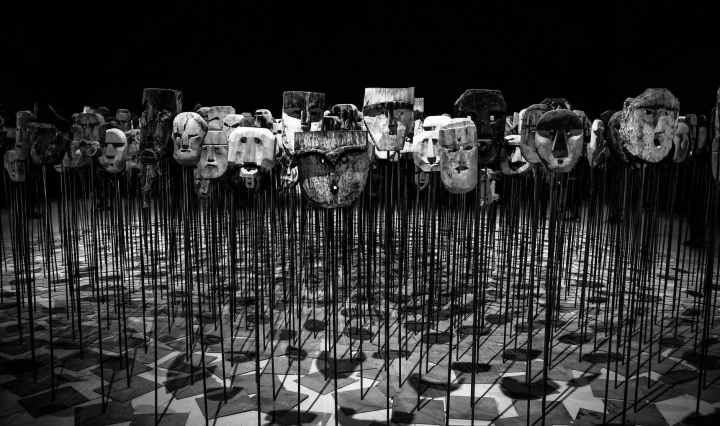
Horațiu Rădulescu’s streichquartett nr. 4 opus 33

I recently listened to Horațiu Rădulescu’s streichquartett nr. 4 opus 33 performed by the Arditti quartet. The vast spectral sound-world of 128 strings is striking and quasi-fantastical. About Horațiu Rădulescu: Roman-French composer Horațiu Rădulescu frequently employed spectral techniques in his compositions. His sound-worlds are described as ‘cosmic’, ‘strange’ and ‘archaic’.  Oliver Messiaen described Rădulescu as a composer who ‘contributed to the renewal of musical language’. [1] About streichquartett nr. 4 opus 33:  This piece is composed for nine spatialised string quartets. A central live string quartet surrounded by an audience who are, in turn, surrounded by eight string quartets which, according to Rădulescu, … Continue reading Horațiu Rădulescu’s streichquartett nr. 4 opus 33

Considering Compositional ‘Spaces’ as ‘Heterotopias’: ‘Music and/as Process’ Symposium

I presented the following at the ‘Music and/as Process’ Symposium in Huddersfield last summer.  Although my research has developed since then, this presentation is still relevant to my current perspective on music’s relationship with society. More than anything else, though, I am fascinated with Michel Foucault’s article ‘Of Other Spaces’. His concept of ‘Heterotopia’ opens up  a perspective on society that resonates with my own ideas about composition. Art is invariably a social event and we must acknowledge this in our quest to explore its mechanics. An awareness of Foucault’s ‘Heterotopology’ can potentially guide the compositional process and expand the existing perspective of semiotics that music and … Continue reading Considering Compositional ‘Spaces’ as ‘Heterotopias’: ‘Music and/as Process’ Symposium

Compositional Form: A Multidimensional Interstice?

The following is an area of my research which I presented on at a postgraduate conference in December, and something I hope to talk more about in the future as it develops. In this presentation, I discuss my current composition Interstice, the ‘form’ of which relies on the participation of an interactive audience via the internet and an iPhone app. Due to a specific type of interactivity, Interstice’s timeline is complex, and its participatory element results in the roles of ‘performer’ and ‘audience’ being indistinguishable. Interstice treats the audience as additional compositional ‘objects’ amongst which perceived ‘meaning’ and ‘function’ interact within a ‘frame’ that is multidimensional and … Continue reading Compositional Form: A Multidimensional Interstice?

Review: Dr Timothy O’Dwyer, ‘Folding Machines – Approaches to Improvising and Composing Inspired by the Philosophy of Gilles Deleuze’

The following is a review of a talk given by Dr Timothy O’Dwyer on 27th February at the University of Leeds, School of Music. I must mention that the following account is by no means exhaustive of Deleuzian thought, in fact it only touches on one aspect of it. However, I am writing about this talk because it seems to offer an accessible starting point to comprehending one of Deleuze’s concepts. It also demonstrates how applying aesthetics and philosophy to composition can offer a different perspective on a familiar act and therefore a potentially different outcome. This is something I … Continue reading Review: Dr Timothy O’Dwyer, ‘Folding Machines – Approaches to Improvising and Composing Inspired by the Philosophy of Gilles Deleuze’

Upcoming Performances: Leeds Contemporary Music Festival

LSTwo ensemble will perform  ENERGY CANNOT BE CREATED I: the title is an image for chamber ensemble  in the Leeds Contemporary Music Festival in May. They will also perform music by Harrison Birtwistle, James Dillon, Emmanuel Nunes, and Oliver Thurley. The Carbon Loop for seven percussionists will be performed in Leeds in May by percussion ensembles of the Musikhochschule Freiburg and the University of Leeds. Continue reading Upcoming Performances: Leeds Contemporary Music Festival

Graphic Score: Notes Inégales, Tableaux Vivants, and CROSSWOR[K]

Notes Inégales realised my graphic score CROSSWOR[K] in the ‘Tableaux Vivants‘ concert earlier this week. The concert also featured traditional klezmer music as well as compositions by Peter Wiegold, The Notes, Marcello Messina, Antti Sakari Saario and Martin Iddon, and visuals by Adam York Gregory (listed here in order of appearance in the concert programme). The score for CROSSWOR[K] is as pictured below. This piece resulted from a request to write a graphic score on a postcard specifically for Notes Inégales. CROSSWOR[K] is structured like a crossword practically as well as visually.  Deciphering a performance from this score resembles the process one goes … Continue reading Graphic Score: Notes Inégales, Tableaux Vivants, and CROSSWOR[K]

Foucault, Michel, ‘A Preface to Transgression’, in Bataille: A Critical Reader, ed. by Fred Botting and Scott Wilson (Oxford: Blackwell Publishers, 1998), pp. 24-40

Although not about music, Foucault’s ‘A Preface to Transgression’ is discussed in musicology and has inspired compositions such as James Dillon’s Blitzschlag. [1] On first engagement, frequent rhetorical questions, and sentences with multiple clauses add an ambiguous quality to the overall message, but this is waylaid on each re-read when the questions begin to facilitate engagement with each concept. As such, Foucault teaches his point rather than dictates it. Through examples of Bataille’s work, and reference to the thoughts of other philosophers, for example Kant and Nietzsche, Foucault explains how transgression is neither negative nor positive, and because transgression is the act of … Continue reading Foucault, Michel, ‘A Preface to Transgression’, in Bataille: A Critical Reader, ed. by Fred Botting and Scott Wilson (Oxford: Blackwell Publishers, 1998), pp. 24-40

Camilleri, Lelio, ‘Shaping Sounds, Shaping Spaces’, Popular Music, 29.2 (2010), 199-211

A relatively new article referenced in pop and rock music literature, Camilleri portrays how ‘sonic space’ can only be fully explored through the techniques of acousmatic music. With diagrams and references of popular music, this article provides an understandable explanation of ‘sonic space’ being a multidimensional world comprising the interaction of, what Camilleri terms, ‘localised space’, spectral space’, and ‘ morphological space’. The distinction between time-dependent and time-independent ‘sonic space’, a pertinent perspective within the scope of this bibliography’s topic, is made when Camilleri explains that ‘localised space’ focuses on a sound’s situation and movement; ‘spectral space’ focuses on timbre, … Continue reading Camilleri, Lelio, ‘Shaping Sounds, Shaping Spaces’, Popular Music, 29.2 (2010), 199-211


Stockhausen, Karlheinz, ‘Music in Space’, Die Reihe, 5 (1961), 67-82

Despite being a widely referenced article in the field of spatialised and electronic music, [1] Stockhausen’s contribution to Die Reihe has received mixed reactions: the language being described as needlessly complex, Stockhausen has been accused of not understanding his topic as well as he portrays. [2] Contrastingly, a more positive review suggests that Stockhausen’s contribution to Die Reihe is the most sophisticated out of the journal’s seemingly random content. [3] ‘Music in Space’ is generally understandable and only ventures into ambiguity with the inclusion of diagrams that, on first glance, require more explaining. Although deep focus and several reads lessen this initially apparent complexity, some background knowledge in acoustics … Continue reading Stockhausen, Karlheinz, ‘Music in Space’, Die Reihe, 5 (1961), 67-82

‘Dry Veins’ & the ‘Leeds Lieder + Song Festival’ 2012

Dry Veins was first performed in the LeedsLieder+ Song Festival in October 2012. For a concert review of this performance, click here. The narrative of Dry Veins is a product of collaboration with the poet John Darley whose spatial poetry can be glimpsed from the image of the song’s front cover (pictured below). The narrative is not gender-specific; it tells the story of a stonecutter who falls in love with ‘their’ own statue. The stone cutter’s longing desire to be at one with their creation is fulfilled when they gradually turn to stone and eventually disintegrate into dust. Dry Veins explores idealism versus reality within … Continue reading ‘Dry Veins’ & the ‘Leeds Lieder + Song Festival’ 2012